
| 时间: 2026-04-07 | 次数: |
个人简介: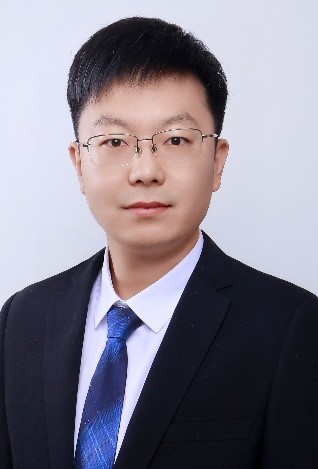
周丙新,男,1991.04
博士,讲师(内聘副教授),硕士生导师
E-mail: bxzhou@hpu.edu.cn
教育及工作经历:
2021.07至今 河南理工大学 材料科学与工程学院 讲师
2019.07~2021.06 湖南大学 材料科学与工程学院 博士后/副研究员
2014.09~2019.07 湖南大学 物理与微电子科学学院 硕博连读
2010.09~2014.07 周口师范学院 物理与电信工程学院 学士
主要研究方向:
光电催化分解水制氢气;光电化学传感器;锂、钠、钾离子电池;第一性原理。
教学情况:
主讲本科课程:材料物理性能,智能材料结构力学
主讲研究生课程:氢能与燃料电池,氢能与光电催化
科研项目:
1.国家自然科学基金青年基金,近红外光响应的异原子掺杂二维非晶异质结的构建及其催化性能研究,2024/01-2026/12,30万,主持。
2.河南省博士后项目,基于氢键和配位键作用的超分子自组装构建非晶金属氧化物/碳/氮化碳高效光催化剂,2023/01-2024/12,10万,主持。
3.河南理工大学博士基金,基于超分子自组装制备g-C3N4/TMOs纳米管异质结及其光催化性能研究,2021/01-2024/12,8万,主持。
4.中国博士后面上项目,一种构建2D/2D g-C3N4/金属氧化物异质结的普适策略,2020/04-2021/7,8万,主持。
5.河南省青年基金项目,异原子掺杂超薄非晶过渡金属氧化物/g-C3N4二维异质结的构筑及其催化性能,2023/01-2024/12,3万,主持。
6.国家自然科学基金面上项目,二维碳化钼迈科烯Mo2C_MXene的制备及其光催化产氢性能,2024/01-2027/12,50万,参与。
7.国家自然科学基金面上项目,基于g-C3N4量子点的高效宽光谱响应多级结构复合材料的构建及其光催化性能的研究,2018/01-2021/12,60万,参与。
科研成果:
以第一作者和共同作者在Advanced Functional Materials, Applied Catalysis B: Environmental, ACS Nano, Nano-Micro Letter,Journal of Colloid and Interface Science, Chemical Engineering Journal等国际著名期刊发表论文50余篇,谷歌学术总被引2000余次。
部分代表性论文:
1. Bing-Xin Zhou, et al. General self-fission strategy via supramolecular self-assembly for high-yield and cost-effective synthesis of g-C3N4 nanostructures for photocatalytic hydrogen evolution. Journal of Colloid and Interface Science, 2025, 695, 137787. SCI一区TOP,IF=9.7
2. Bing-Xin Zhou, et al. In-situ co-growth of 2D/1D g-C3N4/a-WOx amorphous heterojunctions for near-infrared-driven photocatalytic hydrogen evolution, Separation and Purification Technology, 2025, 372, 133455. SCI二区TOP,IF=8.2
3. Bing-Xin Zhou, et al. Generalized Synthetic Strategy for Amorphous Transition Metal Oxides-Based 2D Heterojunctions with Superb Photocatalytic Hydrogen and Oxygen Evolution, Advanced Functional Materials, 2021, 31(11): 2009230. SCI一区TOP,IF=19.9
4. Bing-Xin Zhou, et al. Dimensional transformation and morphological control of graphitic carbon nitride from water-based supramolecular assembly for photocatalytic hydrogen evolution: from 3D to 2D and 1D nanostructures. Appl. Catal., B, 2019, 254: 321-328. SCI一区TOP,IF=22.1
5. Bing-Xin Zhou, et al. Type-II/type-II band alignment to boost spatial charge separation: A case study of g-C3N4 quantum dot/a-TiO2/r-TiO2 for highly efficient photocatalytic hydrogen and oxygen evolution. Nanoscale, 2020, 12, 6037.
6. Bing-Xin Zhou, et al. Theory-driven heterojunction photocatalyst design with continuously adjustable band gap materials, J. Phys. Chem. C, 2018, 122(49): 28065-28074. IF=4.31
7. Ding Shuangshuang; Zhou, Bing-Xin; et al. (NH4)2Mo3S13 with High Sulfur/Molybdenum Ratio as High Reversible Anode for Sodium/Potassium Ion Batteries. ACS Nano, 2020, 14, 9626−9636. SCI一区TOP
8. Wang, Xiao-Rui, Bing-Xin Zhou*,et al. 2D Amorphous CoO Incorporated g-C3N4 Nanotubes for Improved Photocatalytic Performance,Phys. Status Solidi RRL 15.9 (2021): 2100254. 本科生一作,封面文章。
9. Shuang-Shuang Ding, Bing-Xin Zhou, et al. Three-Dimensional Self-assembled Hairball-Like VS4 as High-Capacity Anodes for Sodium-Ion Batteries. Nano-Micro Lett., 2020, 12(1): 39. SCI一区TOP,封面文章。
10. Yuan-Yuan Li, Bing-Xin Zhou, et al. A host–guest self-assembly strategy to enhance π-electron densities in ultrathin porous carbon nitride nanocages toward highly efficient hydrogen evolution. Chemical Engineering Journal, 2022, 430, 132880.
11. Yuan-Yuan Li, Bing-Xin Zhou, et al. Doping-induced enhancement of crystallinity in polymeric carbon nitride nanosheets to improve the visible-light photocatalytic activity, Nanoscale, 2019, 11, 6876-6885.
10. Bo Li, Yuan Si, Bing-Xin Zhou, Qian Fang, Yuan-Yuan Li, Wei-Qing Huang, Gui-Fang Huang. Doping-induced Hydrogen Bond Engineering in Polymeric Carbon Nitride to Significantly Boost the Photocatalytic H2 Evolution Performance. ACS Appl. Mater. Interfaces, 2019, 11(19): 17341-17349.
12. Hua-Wei Zhang, Yuan-Yuan Li, Wei-Qing Huang, Bing-Xin Zhou, Shao-Fang Ma, Yi-Xin Lu, An-Lian Pan, Gui-Fang Huang, Hollow BCN microrods with hierarchical multichannel structure as a multifunctional material: Synergistic effects of structural topology and composition. Carbon, 2019, 148, 231-240.


